For the third project, we had a substantial revision of our previous project. Some of the revisions included a new thesis and adding additional texts to our previous project. In this project a naysayer and metacommentary were also incorpated from project 2.
Logan Flor Project 3 First Draft (1).docx
Logan Flor Project 3 Final Draft (1).docx
Learning Outcome 1: Revision
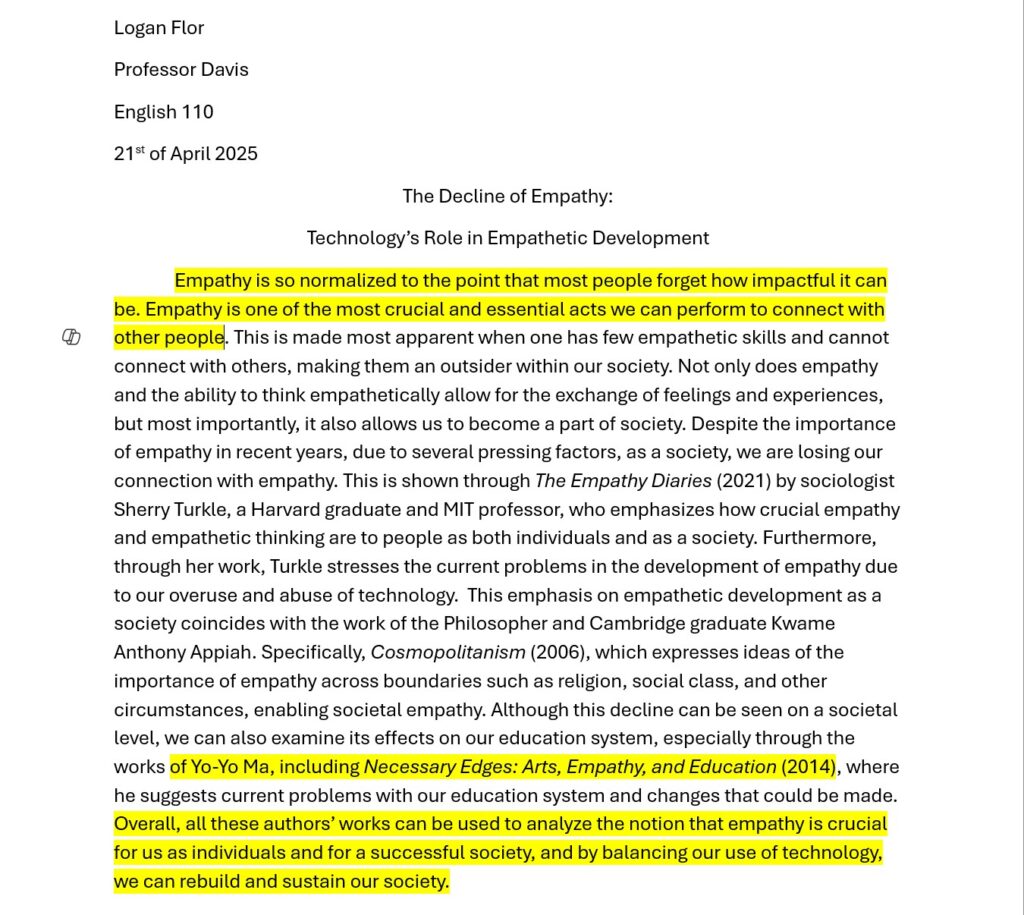
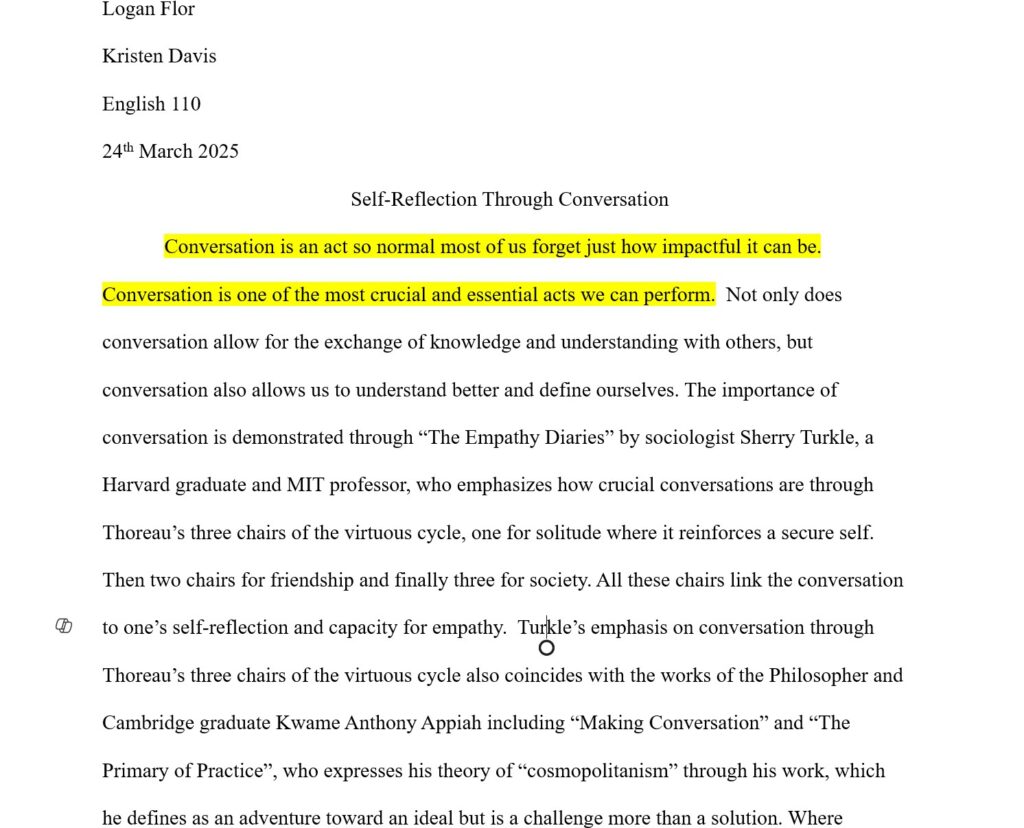
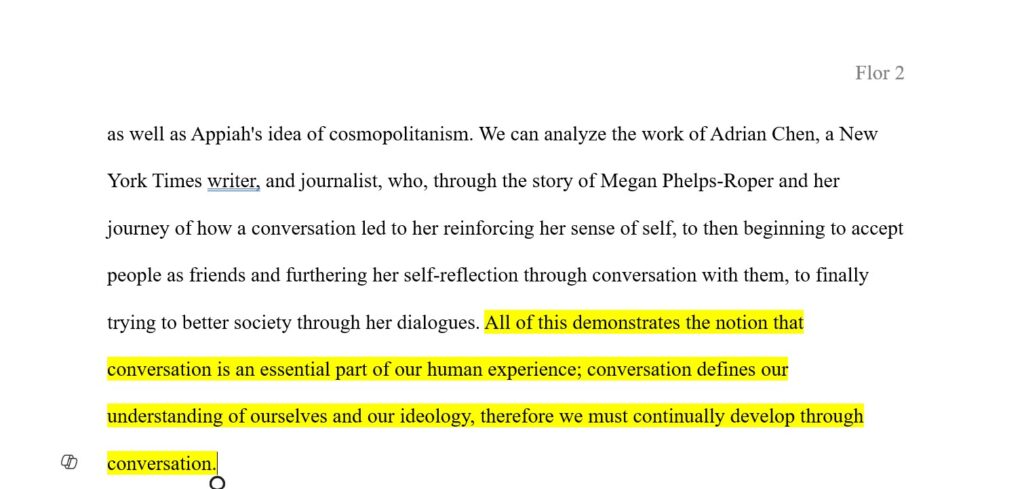
For this course, the first learning outcome states that students must be able to “demonstrate the ability to approach writing as a recursive process that requires substantial revision of drafts for content, organization, and clarity (global revision), as well as editing and proofreading (local revision)”. In this revision process, students must first revise their early drafts with big changes that will build the foundation for the rest of the essay. These big changes or global revisions can include altering the thesis, the inclusion of different textual evidence, or changing the structure of the essay. Then, after global revisions, the student would move on to the smaller or local revisions, which can include fixing punctuation, spelling, and grammar mistakes. Throughout this course, I believe that I greatly improved in both the global and local aspects of the revision process. At the beginning of the semester, I did not put much emphasis on the revision process, barely altering my drafts, though now I put much more emphasis on the revision process. The images above demonstrate the emphasis I put into the revision process, comparing the first and final draft of project 3. The global revision part of the process can be seen within the introduction, which shows I altered my thesis from a focus on communication to a focus on empathy. I made this change because I felt that it was a more impactful topic, considering the texts used throughout the course, and adding text to further support my new thesis. This global change also subsequently resulted in more global changes, such as the structure of my essay and the organization of evidence. Then, after completing, I moved onto the local revision portion of the process, though unlike the beginning of the semester, where I only looked for common errors like spelling and sentence errors. I was now looking for local revisions like sentence clarity, repeated words or phrases, and word choice. Improving not only the correctness of my sentences but, also the impact of them.
Learning Outcome 2: Integrating Sources
The second learning outcome states that students must be able to “Integrate their ideas with those of others using summary, paraphrase, quotation, analysis, and synthesis of relevant sources.” Considering this learning outcome, students should recognize when to quote, summarize, or paraphrase information from a source. The student should also use quotes when their exact wording is crucial. Otherwise, summarize or paraphrase the information. While ensuring that all evidence supports your ideas and claims. I feel that I improved greatly in integrating sources in my writing. At the beginning of the semester, I struggled with the integration of sources, only using poorly integrated quotes and shying away from both paraphrasing and summarization in my writing. Comparatively, though, in my final project, I effectively integrate quotes as evidence to support my thesis. One example of this is in paragraph five where I was explained “Thoreau’s virtuous circle” concerning the development and subsequent possible solutions concerning declining empathy ““these three chairs plot the points on a virtuous circle that links conversation to the capacity for empathy and self-reflection” in this case this specific passage supported and connected back to my thesis. In other instances of my essay, I chose to paraphrase as the specific wording of the quote was not crucial. One example of this was in the second paragraph, where I chose not to use an exact quote but instead chose to paraphrase Turkle’s views on the problems with abuse of technology. Overall, I improved not only in the integration of sources but also expanded and improved on my use of quotes, summarization, and paraphrasing.
Learning Outcome 5: MLA
Learning outcome #5 states students should be able to, “Document their work using appropriate conventions (MLA)”. At the beginning of this course, I greatly struggled with both proper in-text citations and the works cited page, making small errors like including the author’s name in the in-text citation even though their name was already stated before. Throughout this project, I have successfully demonstrated the use of MLA formatting, including proper in-text citations and the subsequent works cited page. I also formatted my writing according to MLA format, including the font Times New Roman in size 12, double-spacing, and page headers. One example of this is that when I was citing Sherry Turkle and had already mentioned her name, my in-text citation only included the page number, demonstrating the improvement in my MLA formatting.
Learning Outcome 6: Control sentence-level error
Learning outcome #6 states that students should be able to, “Control sentence-level error (grammar, punctuation, spelling).” At the beginning of this course, I was not in control of my sentence-level errors, making common mistakes like fragmented or run-on sentences due to overlooking the local revision process. Though comparatively, now I can control sentence-level errors through rigorous local-level revision. Throughout this project, I have put great emphasis on that portion of the revision process, looking for common errors. Such as repetitive words or phrases, as it takes away from the meaning of the paragraph. Another common error I realized within my writing was that my sentences were not concise, and that was taking away from their meaning. To fix this, I tried to take away any words or phrases that do not contribute to the meaning of the sentences. Overall, I practiced and greatly improved my local revision process.
